


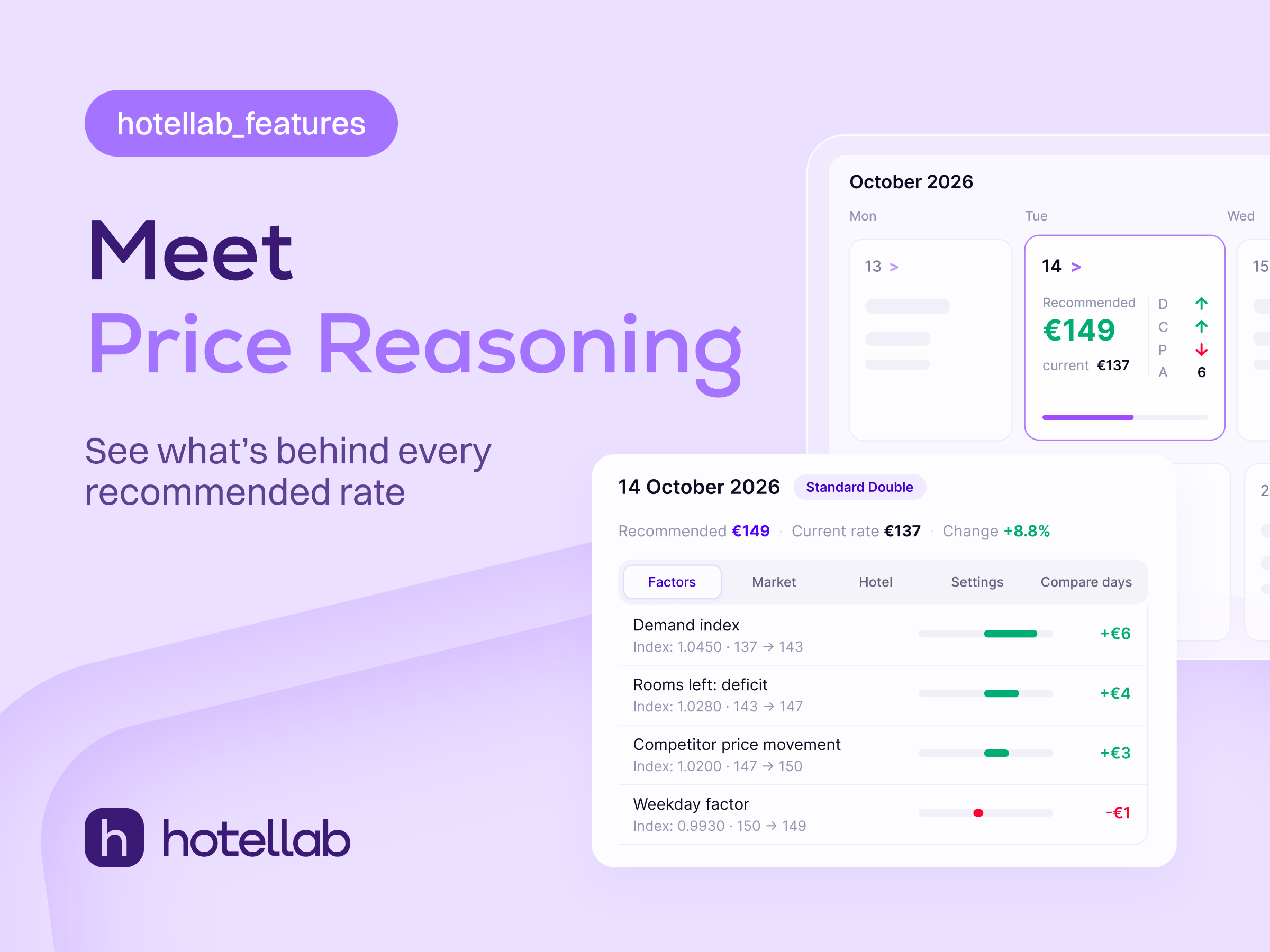
Your RMS recommends €149. Your current rate is €137. If your owner asks why, do you have an answer?
No single formula works for the right rate for a hotel room. Every hotel is different. Its market differs, its competitors differ, and so do its strategy, booking patterns, and pricing rules.
That’s why a good pricing recommendation must consider much more than demand or competitor rates alone. The more factors that go into a recommendation, the more important it is to understand where the final number came from.
One hotel room, more than 100 pricing factors
At hotellab, we don’t calculate rates in the same way for every property.
The system is set up around each hotel: its pricing strategy, competitors, market, occupancy rules, and other individual settings. The system calculates recommended rates using more than 100 factors, with their importance varying by property and date.
The final recommendation is one number. But that number is the result of many things happening at the same time.
Demand may be growing. Your booking pace may be ahead of normal. Several competitors may have increased their rates. Your occupancy may have reached a certain level. Your own pricing rules may also affect how far the rate can move.
Automation solves the calculation. But what about the reasoning?
This level of complexity is exactly why pricing is automated. An RMS can process all these signals at once and keep adjusting recommendations as conditions change.
But automation creates another challenge: the more factors behind a rate, the harder it is to understand why the system recommended that exact number.
And that matters when you’re the one making the final pricing decision.
Back to the €149 from the beginning. Without any context, you can either trust it or start checking the data yourself to understand what changed.
That gap is what makes automated pricing feel like a black box.
What to check when a rate looks off
Whatever system you use, these are the questions worth asking before you accept or override a recommendation.
— Has demand for the date changed? Look at how demand in your market is moving for that date, not just your own bookings. A rate that looks high might simply be following the market.
— Are you ahead of or behind your usual pace? If the date is filling faster than usual, a higher rate makes sense. If it's behind, a rate increase deserves a closer look.
— What are your competitors doing? Check several hotels in your comp set, not just one. Keep in mind that rate shoppers don't always see mobile rates or Genius discounts on Booking.com, so the competitor price you see may not be what guests see.
— Are your own rules shaping the price? Minimum and maximum rates, occupancy thresholds, and other settings can stop a rate from moving as far as the data suggests. Sometimes the answer to "why this price?" is a rule you set months ago.
— How does the date compare with its neighbors? Look at the days before and after, and at the same weekday in other weeks. A rate that looks strange on its own often makes sense next to the dates around it.
Doing this for one date takes time. Doing it for every date in a season, every day, isn't realistic.
Making the logic visible
The Price Reasoning feature in hotellab RMS is designed to solve this.
 For any date in the price calendar, you can see the recommended rate, what influenced it, and which factors had the biggest impact.
Instead of trying to rebuild the calculation yourself, you can check the reasoning in one place:
- Factors: what pushed the recommended rate up or down and how significant each factor was.
- Market: current demand, your position against competitors, and market trends.
- Hotel Insights: live data from your PMS, including occupancy and booking pace.
- Your Settings: the pricing and occupancy rules set for your hotel.
- Compare Days: how the selected date compares with adjacent dates and similar days of the week.
Every number here is real. It uses the same data as your usual reports. Price Reasoning simply brings the relevant information together for a specific date.
Each explanation also has a quick feedback option. Users can say the logic is clear, that they don't understand it, or that they understand it but disagree.
"After more than 12 years in revenue management, I'm sure of one thing: a rate you can't explain is hard to defend. To your GM, to your owner, and most of all to yourself," says Nikolaos Tsitsoulis, Co-Founder and Commercial Director at hotellab. "And if you look at the logic and disagree, we want to know. That's why there's a button for exactly that."
From trusting the recommendation to checking it
The RMS still processes more than 100 factors. But now, when it recommends €149, you can see what led to that number, check the data behind it, and make the final decision yourself.
Price Reasoning is now available in hotellab RMS. If you'd like to see how it works, visit the hotellab.io website
hotellab is an all-in-one revenue management platform for hotels. It supports 500+ hotels across 19 countries. Book a demo with our team at hotellab.io.