


Most resorts have some form of technology in their daily operation.
There are platforms out there for guest messaging, housekeeping, maintenance, restaurant reservations, activities and task management. Some support individual departments, while others coordinate work across several teams.
Yet much of the real operation still happens outside them.
It happens in spreadsheets and emails, in group messaging chats and in printed forms, manual handovers and follow-up checks.
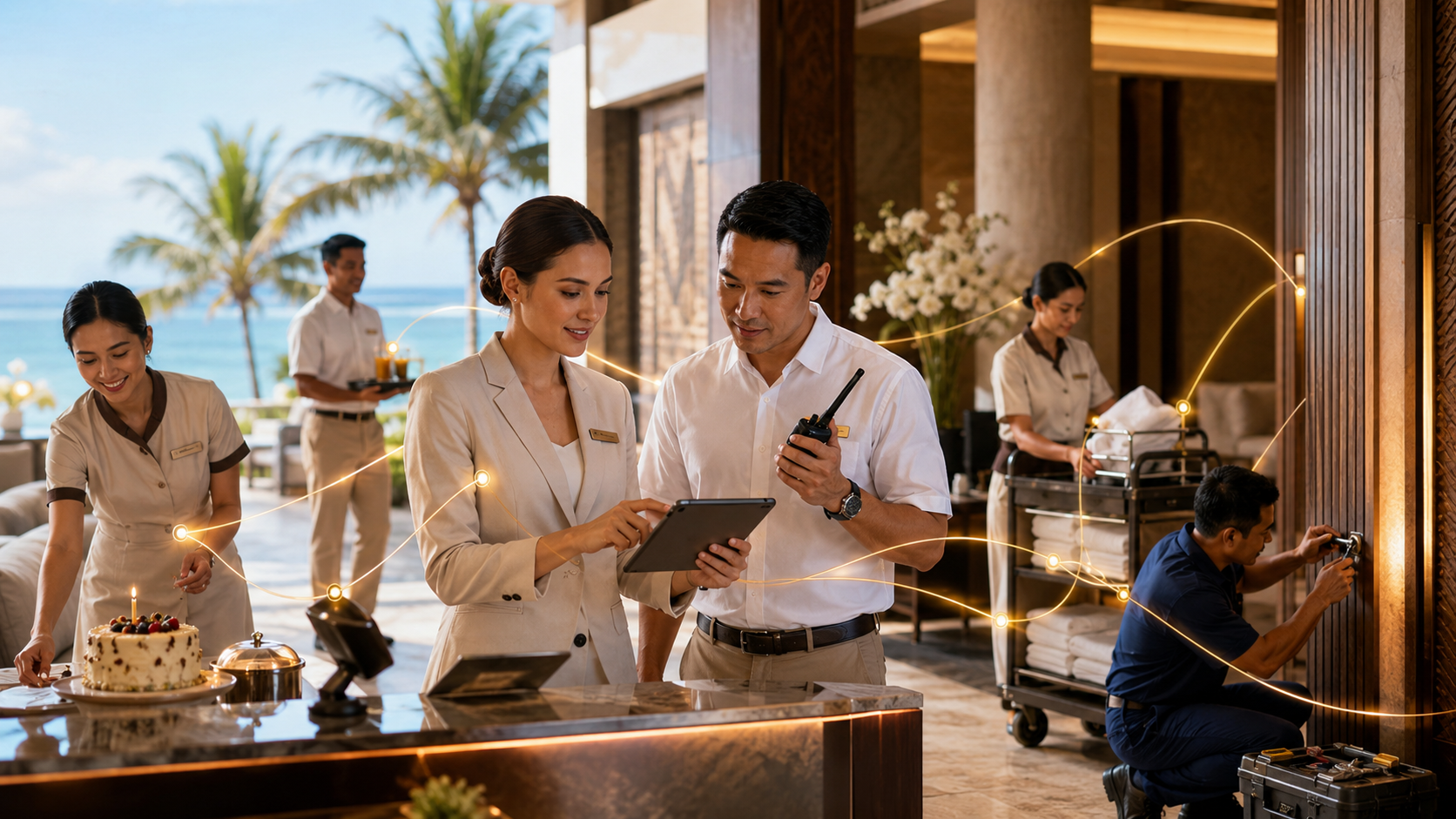
Together, these processes form a Human Operating Layer: a parallel system powered by resort staff to manage the work that falls between the official platforms.
The Work Between the Systems
Each platform may perform its own role extremely well. The challenge however is that resort operations rarely remain within one system or function.
A simple guest request might begin as a message, but triggers work across several departments and needs to be monitored until the final outcome is delivered.
Different platforms may manage certain parts of that journey. The Human Operating Layer manages the rest.
Consider a guest requesting a birthday cake.
Workarounds Have Become Operational Infrastructure
Spreadsheets, group chats and manual processes are often described as workarounds whereas in reality, many resorts depend on them every single day.
But each workaround creates another place to look, another process to remember and another dependency to manage.
Eventually, the workaround stops looking temporary and it becomes part of the resort’s operating infrastructure.
Staff Carry the Complexity
The Human Operating Layer does not operate automatically. Resort staff make it work. They interpret requests, transfer information, update spreadsheets, alert colleagues and chase outstanding actions. They remember which process applies, where information is held and who needs to act next.
In effect, people become the connection between the resort’s systems.
This work is easy to underestimate because it is spread across hundreds of small actions. Each action may take only a few minutes. Across multiple teams, shifts and guest requests, those minutes accumulate and so to does the risk of something going wrong.
Every manual step creates another opportunity for information to be delayed, duplicated, misunderstood or missed.
The individual systems may all be working correctly but the staff still carry the complexity of making them work together.
The Operation Depends on What It Cannot Easily See
The Human Operating Layer often remains hidden because resort teams are so effective at compensating for it. Guests still receive their cakes. Transfers are arranged. Maintenance issues are resolved. Restaurant bookings are confirmed.
The outcome is delivered, but the effort behind it is largely invisible. Because the operation continues to function, its dependence on these informal processes can be difficult to recognise.
A useful question for any resort is:
What would stop working if every spreadsheet, group chat and manual check disappeared tomorrow?
The answer reveals where the formal technology ends and staff have to take over.
Hospitality will always depend on people, judgement and communication. But those strengths should be used to care for guests, solve problems and create memorable experiences—not to hold disconnected processes together.
The Human Operating Layer is very likely keeping the resort running.
The question is how much complexity the team is carrying to sustain it.
Building a Better-Connected Operation
The answer is rarely to replace every system a resort already uses.
The opportunity lies elsewhere: creating an operational layer that brings systems, departments and workflows together, giving teams visibility of the complete guest journey while reducing the need for spreadsheets, emails and manual follow-up.
Instead of staff acting as the connection between disconnected systems, the operation itself becomes connected.
This is not about replacing people or removing the judgement and flexibility that hospitality depends on.
It is about allowing those strengths to be focused where they create the most value: caring for guests, solving problems and delivering exceptional experiences.