


Operational inefficiency rarely announces itself.
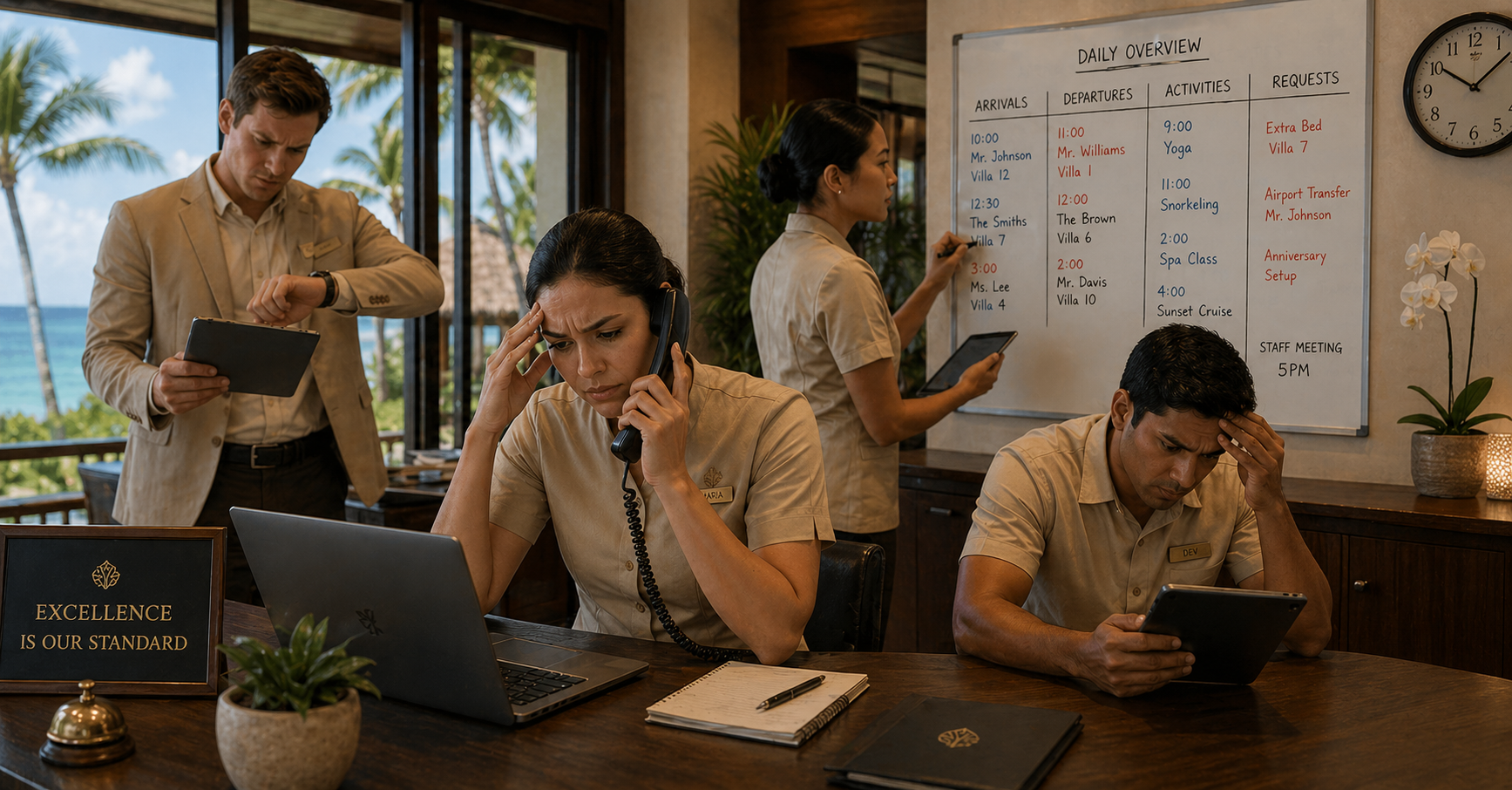
More often, it hides in plain sight, buried in spreadsheets, endless group chats, disconnected software, and the workarounds your team has gradually accepted as part of the job.
The reality is that many resorts are operating less efficiently than they realise.
If you're wondering whether your operations are supporting your team as well as they should, these are five signs worth looking out for.
1. Your day depends on spreadsheets, group chats, and multiple disconnected systems
Spreadsheets are easy to adopt, which is exactly why so many resorts still rely on them. But as operations grow more complex, they quickly become difficult to maintain, especially when multiple people are updating information, cross-checking data, or relying on them to make decisions.
The same applies to using separate apps for different parts of your operation. What starts as flexibility often becomes fragmentation.
Then there are the group messaging platforms. Department heads are often part of dozens of different chats, receiving hundreds of notifications every day, many of which have little or nothing to do with the task they're trying to complete.
When your team is constantly switching between systems just to stay on top of daily operations, it's a strong indication that your processes are creating unnecessary friction rather than removing it.
2. Your systems are taking time away from your team
Your team should be focused on delivering exceptional guest experiences, not spending valuable time managing inefficient processes.
When everyday work involves chasing updates, entering the same information more than once, or correcting avoidable mistakes, inefficiency has already become part of the workflow.
The work still gets done.
But every unnecessary step reduces productivity, slows decision-making, and leaves less time for the work that actually adds value.
Operations should support your people, not create more work for them.
3. Things keep slipping through the cracks
Missed tasks.
Forgotten requests.
Delayed responses.
These problems are rarely caused by a lack of effort. More often, they're the result of systems that don't provide enough visibility.
When information is scattered across multiple tools and manual processes, it's almost inevitable that something will be overlooked.
If you've ever found yourself asking, "How did nobody catch this?", it's probably time to evaluate the systems behind the operation rather than the people working within it.
4. You don't have a real-time view of your operation
Can you see what's happening across your resort at any given moment?
Or do you need to jump between different systems, contact multiple team members, and piece the information together yourself?
Without real-time visibility, decision-making becomes slower and more reactive.
Instead of staying ahead of issues, teams spend their time responding to problems after they've already happened.
Operational excellence isn't simply about completing tasks.
It's about having the visibility and control to make better decisions with confidence.
5. "That's just the way we do things" has become accepted
Perhaps the biggest warning sign of all is acceptance.
Once workarounds become routine, inefficiency starts to feel normal.
Processes stop being questioned because they've simply become part of everyday operations.
The reality is that many resorts are still working with systems that were never designed for the complexity of modern hospitality.
If any of these situations sound familiar, you're certainly not alone.
Across the industry, many resorts continue to rely on spreadsheets, messaging platforms, and disconnected applications because that's how they've always managed their operations.
Moving Towards Simpler, Smarter Operations
The good news is that resort operations don't have to feel this complicated.
More and more operators are replacing fragmented systems with a single platform that brings everything together.
By removing manual processes, improving visibility, and giving every department access to the same real-time information, teams can spend less time managing operations and more time delivering exceptional guest experiences.
Because ultimately, the objective isn't simply to become more efficient.
It's to create an operation that runs with clarity, consistency, and control, without constant firefighting, unnecessary complexity, or systems that make the job harder than it needs to be.