



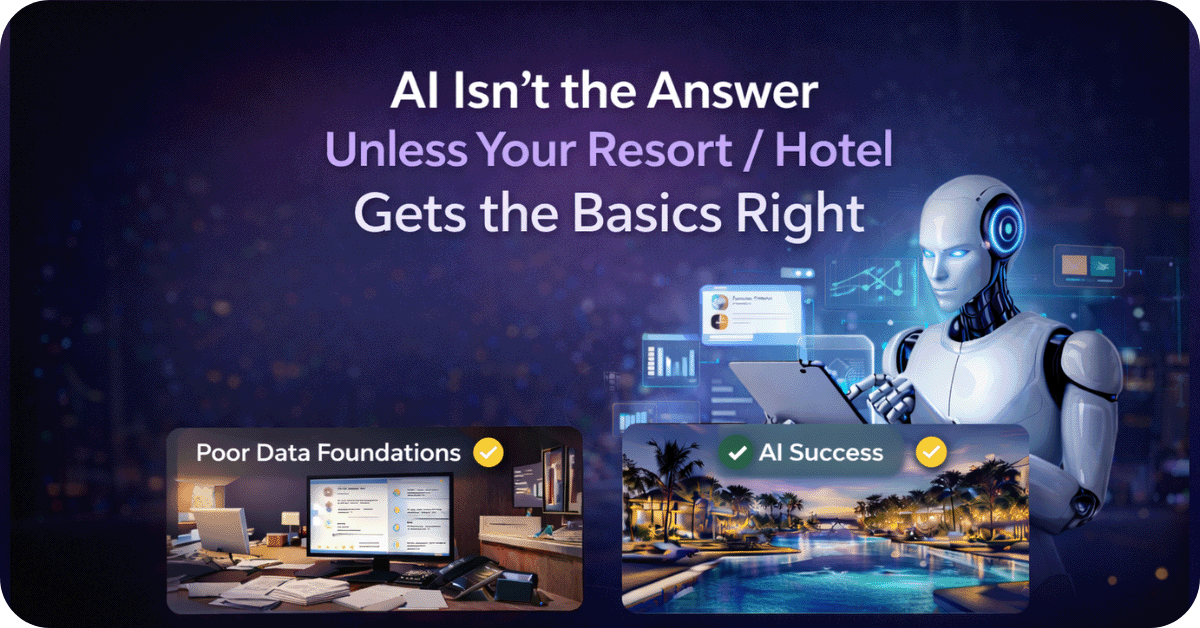
Artificial intelligence is a buzzword that is everywhere in hospitality headlines at the moment, and its promise is always very compelling, more personalised guest service, automated solutions to save hours of manpower, automated recommendations, predictive maintenance and dynamic pricing to name just a few. The impulse to dive straight into an AI solution that promises to fix all your problems is both very strong for those working in resorts and hotels, but at the same time, foolhardy.
The reality is that AI is only as good as the data feeding into it. Too many resorts and hotels are skipping an essential first step in any form of AI adoption strategy: laying the proper foundations. Without clean, structured, and complete data, AI cannot deliver meaningful value. In some cases, it might even do more harm than good.
Even the most advanced AI solutions cannot compensate when a resort or hotel’s basic data collection is poor. AI cannot fix broken systems and processes. As resorts and hotels rush to adopt AI on a promise to improve operations and guest satisfaction, many overlook a hard truth: if your foundations are weak, you have nothing to build on and even the best AI cannot help.
Why core basic data matters
AI systems rely on large volumes of accurate, relevant data to learn and understand patterns and generate insights. In a resort or hotel context, this basic data includes:
Guest profiling for each member of a travelling party
Guest preferences and behaviour
Service usage metrics
Operational performance statistics
Real-time feedback and communication logs
If any of that is missing or unreliable in your current tech stack, the insights AI generates will be below optimal. Worse still, they could misguide your team.
Assessing your readiness
Before thinking about AI, take an honest look at how your resort or hotel handles data today.
Ask yourself these questions as a starting point:
Guest profiles:
Are you collecting and updating your PMS with detailed information on your guests, accurate names, email addresses, preferences, past booking data? All too often we see properties, at best, capturing some details for the primary guest on a reservation, but nothing on the accompanying travelling companions. Whether these details are accurately updated in the PMS is another cause for concern.
Service metrics:
Can you track which services are used, how often, by whom, and when?
Feedback loops:
Are you collecting in-stay feedback, not just post-checkout reviews?
Communication records:
Do you log staff to guest interactions to understand needs and outcomes, or are you utilising standalone chat apps such as WhatsApp?
Synchronised solutions:
Are your systems integrated to provide a single source of data to be looked at and provide a core central source for AI to analyse?
Each of these data points is a building block for AI. Weak or missing data in any category can compromise your results.
Conclusion
There is a lot of talk about AI in hospitality at the moment, and for hoteliers, having clarity on what is important before jumping straight in is essential. AI is going to be a great tool for the industry, but as with any solution that promises a lot, there are certain basic systems and processes that need to be in place for the real benefits to be realised.
What do you think about AI in hospitality? Are you currently confused as to how it can help your property, or are you already embarking on implementing a solution? Share your thoughts in the comments. I would love to hear from you.
To learn more about the company behind this perspective, visit Eleanor’s profile.


.jpg)