


I built DominateAI because I kept watching hotel operators lose ground in a channel they did not even know existed. Not Google. Not OTAs. The AI layer, the ChatGPT conversations, the Gemini travel queries, the Perplexity research sessions; that is where travelers are increasingly going first and, in many cases, not going anywhere else afterward.
We scored over 1,400 US hotel properties on GEO readiness across six dimensions. Not one scored above 80 out of 100. Schema markup averaged 2.75 out of 20. More than 80% of franchise properties had no standalone domain. The gap between where hotels are and where AI needs them to be is not small.
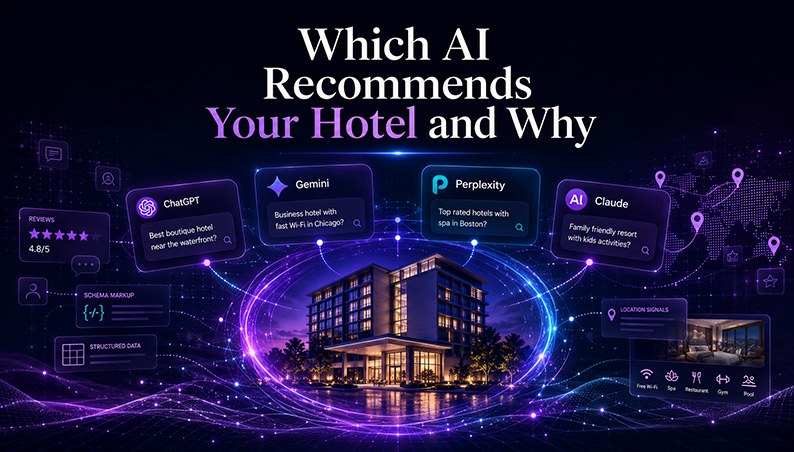
What makes this harder is that each model operates differently. What earns you a citation on Perplexity is largely irrelevant to Gemini. What ChatGPT needs from your website is not what Claude needs. Most operators have not thought about any of this yet, which is both a problem and an opportunity. Here is how each model actually works.
Source: DominateAI GEO Readiness Study, 1,400+ US hotel properties, 2025.
 OTAs account for 55% of all AI travel citations. Hotel websites account for 13.6%. That gap is not inevitable. It is the result of hotels having weaker content, worse structure, and blocked crawlers.
Source: Cloudbeds Hotel AI Recommendations Report, 810 prompts across 145 properties, December 2025.
Architecture sources: OpenAI documentation (Bing); Google Gemini documentation; Perplexity Help Center; Anthropic documentation (Brave Search, Constitutional AI). All confirmed from primary platform sources.
ChatGPT: Bing Is the Battleground, Not Google
ChatGPT has 900 million users. When it searches the web for hotel recommendations, it uses Bing and not Google. This is a detail that catches most hoteliers off guard, because their entire digital marketing strategy has been built around Google.
Your Google Search ranking has no direct bearing on whether ChatGPT can find you. Bing maintains a separate index with its own crawl priorities and authority signals. In independent research analyzing ChatGPT hotel recommendations in New York City, we found that Bing SERP performance was a primary driver of whether a hotel appeared, outperforming Google rankings and even overall brand recognition in some cases. A hotel that dominates Google but is poorly indexed on Bing can be functionally invisible in ChatGPT results.
Booking.com and Expedia also integrated directly into ChatGPT Apps at launch in October 2025. That means OTA inventory is available inside ChatGPT conversations as a first-party integration. Your hotel website has to compete on content quality and Bing authority, and you are not going to out integrate Booking.com.
Source: Search Engine Land / Bing ranking and ChatGPT visibility study, April 2026; Hospitalitynet / Lighthouse ChatGPT hotel discovery report, March 2026; OpenAI ChatGPT Apps launch, October 2025.
What to do:
Submit your sitemap to Bing Webmaster Tools. Most hotel websites have never done this. It takes 15 minutes and directly affects ChatGPT retrieval.
Allow GPTBot in your robots.txt. If it is blocked, ChatGPT’s live search cannot index your site, regardless of how good your content is.
Build Bing authority through the same signals that built your Google authority, i.e., quality backlinks, editorial mentions, consistent NAP; but verify Bing indexation separately.
Entity consistency matters. Your hotel name, address, and category should be identical across your website, Google Business Profile, Bing Places, and OTA listings. Inconsistency creates entity confusion and suppresses AI citations.
Gemini: Google’s Model Plays by Google’s Rules
Gemini sits on top of Google’s index and inherits Google’s ranking logic. That means everything Google has valued for the past decade, i.e., E-E-A-T signals, structured data, authoritative backlinks, verified business information, matters here. The difference is that Gemini synthesizes a recommendation rather than returning a list of links. You are not competing for position ten on a SERP. You are competing for one of three names in a paragraph.
The structural advantage OTAs hold is significant. Booking.com and Expedia have accumulated years of Google authority, thousands of reviews per property, and perfectly structured content. Cloudbeds research found branded hotel chains were 4.43 percentage points more visible than independents across AI recommendations. That gap is driven largely by Gemini, which favors the trust signals that brands and OTAs have built and that independents have not.
Gemini also personalizes. It connects to Gmail, Calendar, and Search history, which means a traveler who has correspondence about a business trip may see hotel recommendations filtered by proximity to their meeting venue without ever asking. Hotels that appear clearly as a specific type of property: business hotel, wellness retreat, family resort, etc., in their structured data and content are better positioned for this personalized retrieval than properties with generic descriptions.
Source: Google Gemini documentation; Cloudbeds Hotel AI Recommendations Report, December 2025; Google Search Central E-E-A-T guidance.
What to do:
Your Google Business Profile is now a GEO asset, not just a local SEO tool. Review volume, recency, photo quality, and category accuracy all feed Gemini. Treat it accordingly.
In our study of 1,400+ US properties, schema markup averaged 2.75 out of 20. The LodgingBusiness schema is the highest-return technical fix available, and it tells Gemini exactly what your property is, where it is, what it costs, and what it offers. Without it, Gemini relies on OTA descriptions of your property.
Content with E-E-A-T signals, such as named authors, specific expertise, verifiable claims, and dated content, has a meaningfully higher citation likelihood than generic property descriptions.
Allow GoogleExtended in your robots.txt to ensure Gemini’s extended crawl can access your content.
Perplexity: The Most Transparent, The Most Actionable
Perplexity is the model I tell most hotel operators to start with, because it is the most legible. Every response shows its citations, such as numbered, clickable, and visible to the user. You can run the same query your potential guests are running, see exactly which properties and sources appear, and work backward from that to understand what you need to fix.
The architecture is different from the others. Perplexity runs its own real-time search engine against an index of over 200 billion URLs and processes queries at tens of thousands of indexing operations per second. Every query triggers a live search. There is no training data lag, and what matters is what is on the web right now and how well Perplexity’s crawler can read it.
Perplexity favors answer-first content. The opening sentence of any section should directly answer the question implied by the heading. Long introductions, marketing language, and vague positioning actively reduce the likelihood of citation. Unique, specific data, such as facts your hotel publishes that no one else has, is the strongest citation signal on Perplexity, because it is the only content the model cannot generate itself.
TripAdvisor carries particular weight here. The Cloudbeds research found that review and UGC platforms account for a meaningful share of AI citations, and Perplexity’s real-time index pulls heavily from review content. Your TripAdvisor review volume, recency, and response rate directly feed Perplexity’s evaluation of your property.
Source: Perplexity Help Center and PerplexityBot crawl documentation; 2025 AI Visibility Report, Digital Bloom (680M+ citations analyzed), December 2025; Cloudbeds Hotel AI Recommendations Report, December 2025.
What to do:
Allow PerplexityBot in your robots.txt. If it is blocked, your content cannot be indexed, and you will not appear in Perplexity citations regardless of content quality.
Run the actual queries your guests would ask, like ‘best boutique hotel near [landmark]’, ‘hotel with [specific amenity] in [city]’, and read the citations Perplexity returns. That is your competitive audit, or reach out to us at Dominateai.ai for a full audit.
Structure your content with question-based H2 headings and direct answers in the first sentence of each section. This is exactly how Perplexity retrieves and extracts information for its responses.
Publish something specific that only your hotel can publish: your exact neighborhood walking distances, your chef’s sourcing philosophy, your sustainability certifications with numbers. Unique facts are the citation currency.
Claude: Factual Density Over Marketing Language
Claude is the model I think about and use the most, mostly because its recommendation logic is the most different from the others, and the most aligned with what good hotel content should look like anyway.
Claude’s web search is powered in part by Brave Search, which maintains its own independent index. Brave Search is a documented retrieval source in Claude-powered applications, representing a third index worth managing alongside Google and Bing. Most hotel operators have never submitted to Brave Webmaster Tools or checked whether their content is accessible to ClaudeBot.
What makes Claude distinctive is its Constitutional AI framework as it is explicitly trained to be helpful, harmless, and honest. In practice, this creates a strong preference for factually dense, verifiable content over marketing language. Claims without specifics, amenity descriptions that use adjectives instead of facts, and copy that reads like a brochure are systematically weaker in Claude’s evaluation than precise, specific, auditable information. ‘Stunning harbor views’ is not a citation-worthy claim. ‘452 square foot rooms with floor-to-ceiling windows on floors 8 through 14 facing the harbor’ is.
Claude integrates source material into synthesized prose rather than displaying numbered citations, which makes it harder to audit than Perplexity. But the underlying logic is consistent. Properties with detailed, structured, factually specific website content perform better than properties that rely on OTA descriptions, which is because OTA descriptions are written for conversion, not for factual completeness.
The Citations API Claude launched in January 2025 also matters for the hospitality tech layer. Tools built on Claude, such as booking assistants, concierge applications, and rate intelligence platforms, can now trace exactly which hotel content they draw from. Hotels with rich, well-structured data get cited more often in those downstream applications than hotels with thin sites.
Source: Anthropic Constitutional AI documentation; Anthropic Citations API launch (TechCrunch, Anthropic blog), January 2025; Brave Search API documentation (Brave Search documented as retrieval source for Claude-powered applications); AWS Bedrock Citations API extension, June 2025.
What to do:
Allow ClaudeBot in your robots.txt. Consider submitting to Brave Webmaster Tools, as Brave Search is a documented retrieval source in Claude-powered applications, alongside Google and Bing.
Audit your website copy for adjective-to-fact ratio. Every vague claim (‘spacious’, ‘luxurious’, ‘stunning’) should be replaced with a specific, verifiable fact. This is the single highest-return content change for Claude visibility.
Room pages, dining pages, and amenity pages with specific, structured facts perform better than a single generic ‘About’ page. Zero percent of hotel websites in the Cloudbeds audit had dedicated room listing pages with structured detail.
If you are evaluating hospitality tech built on Claude, like pricing tools, booking assistants, and guest communication platforms, then ask the vendor whether their tool uses the Citations API. If it does, your content quality directly affects how often your property is surfaced in that tool’s outputs.
The Three Things Every Hotel Should Do This Week
Most hotels are failing at GEO visibility for the same three reasons. Here is where to start:
1. Fix your robots.txt
Check that GPTBot (ChatGPT), GoogleExtended (Gemini), ClaudeBot (Anthropic), and PerplexityBot are all allowed. Blocking any of these removes you from that model’s retrieval pool entirely. This takes 20 minutes and has a higher commercial return than most content investments. Also, add yourself to Bing Webmaster Tools and Brave Webmaster if you have not already.
2. Implement LodgingBusiness schema
In our study of 1,400+ US hotel properties, schema markup averaged 2.75 out of 20. This is the primary structured data signal that tells AI models what your property is, where it is, what it costs, and what it offers. Without it, AI models default to OTA descriptions of your property, and OTAs get the citation. LodgingBusiness schema takes roughly two hours to implement correctly.
3. Replace one marketing claim with one specific fact per page
Start with your homepage and your room pages. Every adjective that cannot be verified, such as luxurious, stunning, world-class, should be replaced with a specific, auditable fact. This improves Claude and Perplexity citation likelihood, strengthens your E-E-A-T signals for Gemini, and makes your content more useful to every model simultaneously.
The hotels that will be invisible in AI search by 2027 are not the ones with bad products. They are the ones with thin websites, blocked crawlers, and no structured data. That is fixable. But the window to fix it before it becomes a distribution problem is closing.
DominateAI scores hotels across various GEO dimensions, including schema markup, factual density, E-E-A-T, semantic clarity, freshness, and technical crawlability, and generates a prioritized action plan. Built specifically for hotel and STR operators.