


As an L&D leader, you are expected to build learning systems around roles while the business reorganizes work around problems. Teams form and dissolve faster, AI absorbs tasks mid-cycle, and internal mobility no longer follows predictable ladders. This creates a growing gap between how work actually moves and how learning is designed to support it.
That gap shows up in familiar ways. Skills frameworks age quickly. Role-based programs struggle to translate into redeployment decisions. High-potential talent looks capable on paper but stalls when responsibilities shift. In this environment, transferable skills become operational assets. They determine whether capability travels with employees as work changes, or stays locked to outdated role definitions.
For learning to remain strategic in 2026, transferable skills must be built deliberately into how people are developed, assessed, and moved across the organization. They form the connective tissue between learning, mobility, and workforce planning. When designed intentionally, they allow L&D to support continuous change rather than chase it.
To make this shift sustainable, organizations often anchor transferable skill development within a broader enterprise learning management framework, one that connects learning initiatives with skills visibility, mobility pathways, and workforce planning, rather than treating development as a series of isolated programs.
What Are Transferable Skills?
Transferable Skills – Simple Definition
Transferable skills are capabilities that remain useful across different roles, teams, and business environments. They are not tied to a specific function or technology. Instead, they describe how people approach work, solve problems, make decisions, and collaborate with others. Because these skills move with employees as responsibilities change, they continue to create value even when job requirements evolve.
Examples of transferable skills include critical thinking, communication, collaboration, adaptability, learning agility, problem-solving, and decision-making. These skills apply across functions and industries, supporting performance in both familiar and unfamiliar situations. As work becomes more dynamic, transferable skills provide the foundation that allows employees to apply new technical skills effectively.
To understand why transferable skills matter so much in today’s skill strategies, it helps to see how they differ from other capability types organizations invest in. Not all skills are built to serve the same purpose. Some are designed for immediate role performance, while others are meant to travel across roles, contexts, and organizations.
Transferable Skills vs Technical Skills
Both skill types are essential, but they solve different learning and workforce problems.
Technical skills help employees perform effectively in their current roles. Transferable skills determine whether that performance continues as work evolves. L&D teams need technical skills to meet today’s requirements and transferable skills to prepare for tomorrow’s shifts.
Transferable Skills vs Proprietary Skills
These skills differ in how tightly they are tied to a specific organization.
Proprietary skills help employees operate effectively inside a specific organization. Transferable skills allow them to move across teams, roles, and challenges with confidence. Together, they create a balanced skill foundation that supports both stability and change.
Examples of Transferable Skills in the Workplace
Transferable skills show up in how work gets done, not just in how roles are defined. These examples reflect skills that apply across functions, industries, and seniority levels, making them consistently valuable as roles and contexts change.
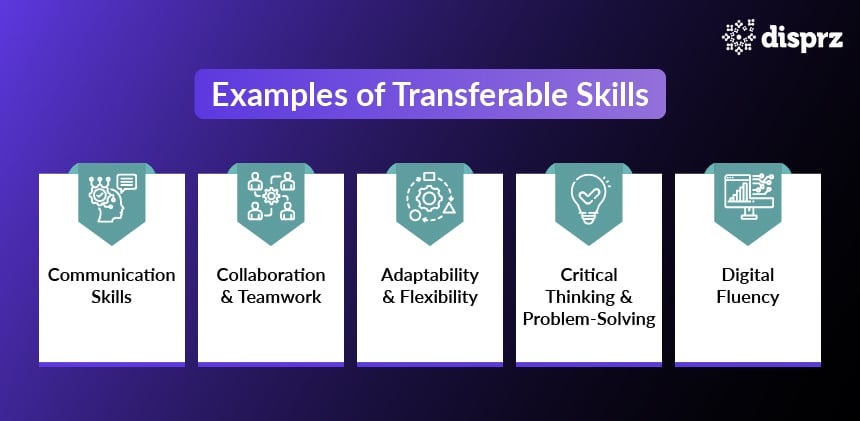
Communication Skills
Communication skills go beyond clear speaking or writing. In the workplace, they show the ability to explain ideas to different audiences, align stakeholders with competing priorities, and translate complexity into action. This includes written communication such as emails, reports, and documentation, as well as verbal communication in meetings, presentations, and decision forums. Strong communicators reduce friction, prevent rework, and help teams move faster with shared understanding.
Collaboration and Teamwork
Collaboration skills enable employees to work effectively across functions, geographies, and working styles. In practice, this means contributing in cross-functional projects, coordinating with remote or hybrid teams, and resolving differences constructively. Employees with strong collaboration skills navigate dependencies, share accountability, and keep work moving even when ownership is distributed across teams.
Top 5 Collaborative Learning Platforms for Employee Development in 2026
Adaptability and Flexibility
Adaptability reflects how well employees respond to change. At work, this includes learning new tools, adjusting to shifting priorities, and taking on evolving responsibilities without losing effectiveness. Adaptable employees remain productive during transitions such as restructures, technology rollouts, or role changes. This skill becomes especially critical as AI and automation continue to reshape tasks and workflows.
Critical Thinking and Problem-Solving
Critical thinking shows up when employees face incomplete information or unclear paths forward. In workplace settings, it involves analyzing situations, weighing trade-offs, and making sound decisions under uncertainty. Problem-solving skills allow employees to diagnose root causes, evaluate options, and act decisively rather than relying on predefined playbooks.
Digital Fluency
Digital fluency reflects comfort with modern tools, platforms, and workflows. It includes the ability to adopt new systems quickly, navigate digital collaboration environments, and use technology to improve efficiency. Digitally fluent employees adapt faster to changing work models and make better use of evolving tools without requiring constant retraining.
Priority List of Transferable Skills in 2026
As an L&D leader, you are preparing people for work that is being reshaped by AI, shifting business models, and continuous reorganization. The skills below represent where you will see the greatest impact on performance, mobility, and long-term workforce readiness. Each one reflects a capability your learning strategy must build intentionally, not assume will develop on its own.
1. Adaptability and Learning Agility
You see adaptability and learning agility at work when employees pick up new tools quickly, adjust to changing responsibilities, and remain effective through constant change. As roles evolve faster than training cycles, you need learning that encourages experimentation, reflection, and continuous skill acquisition rather than one-time upskilling.
2. Communication in Hybrid & AI-Augmented Work
Your teams now communicate across digital channels and increasingly alongside AI tools. This skill shows up when employees frame clear messages, align distributed stakeholders, and explain decisions influenced by AI outputs. You build it by designing learning that strengthens clarity, context-setting, and audience awareness in both human and machine interactions.
3. Critical Thinking and Judgment
As automation takes over routine tasks, you rely on people to make sound decisions in uncertain situations. This skill becomes visible when employees question assumptions, evaluate information quality, and choose actions without complete data. You develop it through scenario-based learning and decision simulations tied to real business contexts.
4. Emotional Intelligence
You experience the impact of emotional intelligence in moments of change, conflict, and feedback. Employees with strong EI navigate pressure, build trust, and sustain collaboration even in ambiguous situations. You strengthen this skill by grounding learning in real workplace interactions rather than abstract behavioral models.
5. Data Literacy (Not Just Analysis)
You need employees who can interpret data and act on it responsibly, not just produce reports. Data literacy shows up when people ask the right questions, recognize limitations, and use insights to guide decisions. You build this capability by focusing learning on sense-making and practical decision use cases.
6. Collaboration Across Roles & Functions
Work increasingly cuts across teams, functions, and geographies. You see this skill when employees manage dependencies, share accountability, and move initiatives forward without formal authority. You can reinforce it by designing learning that mirrors cross-functional problem-solving, promotes employee cross-skilling, and builds shared ownership across the organization.
7. Project & Stakeholder Management
Much of your organization’s work now runs through initiatives rather than static roles. This skill matters when employees plan work, manage expectations, and balance competing stakeholder needs. You support it by integrating project-based learning and real delivery constraints into development programs.
8. Creative and Systems Thinking
You depend on this skill when problems are complex and solutions are not linear. Employees demonstrate it by connecting ideas, anticipating downstream impacts, and designing solutions that work across systems. You can build it by encouraging exploration, pattern recognition, and end-to-end thinking in learning experiences.
9. Leadership Without Authority
You increasingly expect employees to influence outcomes without formal power. This skill shows up when people align peers, drive decisions, and move work forward through credibility and clarity. You develop it by focusing learning on influence, decision framing, and trust-building in real organizational contexts.
Why Employers Value Transferable Skills More Than Ever?
Employers are optimizing for speed, not stability. Work reshapes itself faster than org charts, and capability needs to move just as quickly. Transferable skills matter because they determine how smoothly talent flows when the business changes direction.
Faster Role Changes and Internal Mobility
Internal mobility breaks down when people need to be “retrained” every time responsibilities shift. It works when employees already know how to step into unfamiliar ground.
You see transferable skills at play when:
Employees move into adjacent roles without long ramp-ups
Teams re-form around priorities without losing momentum
Managers trust internal moves instead of defaulting to hiring
For employers, this turns internal mobility into a lever for growth instead of a risk to performance.
Reduced Reskilling Time
Reskilling slows down when learning has to rebuild thinking patterns along with technical knowledge. It accelerates when those foundations already exist.
Transferable skills reduce reskilling time because employees:
Learn new tools by connecting them to prior experience
Ask better questions instead of waiting for instructions
Apply new skills in context, not just in training environments
This is how organizations reskill continuously without pausing productivity.
Better Collaboration and Productivity
Most productivity loss today comes from friction, not effort. Misalignment, unclear ownership, and poor handoffs cost more than skill gaps.
Transferable skills show their value when:
Cross-functional work moves without constant escalation
Hybrid teams stay aligned without over-communication
Decisions happen closer to the work, not higher up the chain
When collaboration improves, employee productivity follows naturally.
Long-Term Workforce Resilience
Resilience is not built through constant retraining. It is built through capability that survives change.
Employers value transferable skills because they:
Keep people effective as roles evolve
Reduce dependence on constant structural redesign
Allow the workforce to absorb disruption without stalling
Over time, this creates a workforce that adapts faster than the market shifts around it.
Importance of Transferable Skills in the Corporate Workplace
Transferable skills determine how smoothly work moves when roles, teams, and priorities shift. Their importance shows up in daily execution, not in capability frameworks.
Versatility Across Roles
You see this when employees step into new responsibilities without waiting for formal role changes. They apply existing skills in unfamiliar contexts and stay productive while learning on the job.
What this enables: Faster response to changing business needs without constant restructuring.
Seamless Transitions Between Teams
Team changes work when people integrate quickly and contribute without extended ramp-up. Transferable skills support clear communication, adaptability to new ways of working, and faster trust-building.
What this enables: Continuity of delivery even as teams reconfigure.
Innovation and Change Readiness
Innovation moves when employees are comfortable experimenting and adjusting courses. Transferable skills help people navigate uncertainty, connect ideas, and respond constructively to change.
What this enables: Change initiatives that progress instead of stalling.
Employee Retention and Growth
Employees stay when they see multiple paths forward. Transferable skills expand career mobility and prepare people for broader responsibility.
What this enables: Stronger engagement and internal progression.
Sustainable Organizational Performance
Organizations perform sustainably when capability survives change. Transferable skills allow the workforce to remain effective through new tools, structures, and strategies.
What this enables: Performance that compounds over time rather than resets.
How L&D Leaders Can Identify Transferable Skills to Build?
Identifying transferable skills is not an abstract exercise. You are looking for capabilities that appear repeatedly across roles, hold up during change, and accelerate performance in new contexts. The approaches below help you surface those skills systematically.
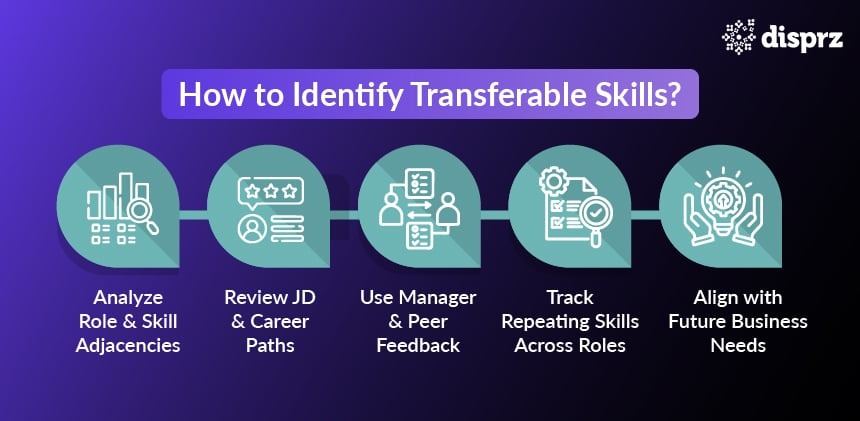
Analyze Role and Skill Adjacencies
Start by looking at how roles evolve rather than how they are defined today. Identify roles employees commonly move between and examine the skills that carry over successfully.
What to do: Map adjacent roles and note the skills that enable smooth transitions. These recurring capabilities are strong candidates for transferable skill investment.
Review Job Descriptions and Career Paths
Job descriptions often reveal more than intended. When you review them together, patterns emerge.
What to do: Scan multiple job descriptions across levels and functions. Highlight skills that appear repeatedly, especially those listed as “required” rather than “nice to have.” Track how these skills show up across career paths, not just within a single role.
Use Manager and Peer Feedback
Managers and peers see transferable skills in action every day. Their input helps you move beyond formal documentation.
What to do: Ask managers which skills help employees succeed when roles expand or priorities shift. Look for feedback themes tied to adaptability, communication, judgment, and collaboration.
Leadership Training for New Managers: Ultimate Guide for 2026
Track Skills That Repeat Across Roles
Transferable skills surface when the same capabilities support success in different contexts.
What to do: Analyze performance reviews, project feedback, and learning data to identify skills associated with strong outcomes across multiple roles. Skills that consistently correlate with performance are worth building deliberately.
Align With Future Business Needs
Transferable skills matter most when they prepare the workforce for what’s coming next.
What to do: Review upcoming business priorities, technology changes, and operating model shifts. Identify the skills employees will need to navigate these changes effectively, not just execute current tasks. Use this lens to validate which transferable skills deserve focus.
How to Build Transferable Skills Through L&D Strategy?
Once you know which transferable skills matter, the challenge shifts from identification to execution. Building these skills requires deliberate design choices across learning, work, and performance systems. This is where L&D strategy either compounds value or stays stuck at intent.
Conduct a Transferable Skills Audit
Start by understanding where transferable skills already show up in your organization.
What to focus on: existing role transitions, high-performing employees, and skills that appear across functions.
What this unlocks: visibility into which skills already travel well and which ones need structured development.
Embed Transferable Skills Into Role-Based Learning
Transferable skills stick when they are developed alongside role capability, not separately.
What to do: map one or two transferable skills into each role-based program, such as decision-making in leadership tracks or communication in technical learning.
What this enables: skill development that feels relevant and immediately applicable.
Use Real-World Scenarios and Projects
These skills develop through practice, not consumption.
What to do: design learning around real decisions, live projects, and workplace scenarios where judgment, collaboration, and adaptability are required.
What this enables: observable skill progression instead of theoretical understanding.
Encourage Cross-Functional Learning
Transferable skills strengthen when employees learn outside their immediate context.
What to do: create opportunities for cross-functional projects, peer learning, and shared problem-solving.
What this enables: broader perspective and faster skill transfer across roles.
Support Managers as Skill Coaches
Managers are the most consistent environment for skill development.
What to do: equip managers to recognize transferable skills in action, give targeted feedback, and reinforce application on the job.
What this enables: continuous development embedded in daily work, not just formal learning moments.
Measure Skill Progression, Not Just Completion
Completion data tells you what was finished. Skill data tells you what changed.
What to do: track how skills evolve over time using signals from learning activity, feedback, and role movement.
What this enables: a clear view of skill progression, readiness, and mobility.
Key Takeaways for L&D Leaders
Most learning strategies still serve roles, while the business now runs on shifting priorities.
The gap between work and learning is the reason why mobility stalls and reskilling keeps restarting.
Transferable skills are the only capability that moves when work reorganizes.
Skills do not compound through experience alone and remain invisible in most L&D metrics.
When learning is designed around real work and manager reinforcement, transferable skills start to scale.
Once skills can be seen strengthening across roles, learning becomes a competitive advantage instead of a cost center.
Conclusion
Building transferable skills breaks down when visibility is fragmented and development happens in isolated programs. Without a clear view of how skills show up across roles, learning remains activity-heavy and outcome-light. What makes this strategy work at scale is the ability to connect skill intent to everyday learning, performance signals, and career movement.
This is where systems designed around skills make a difference. When learning experiences are mapped to skills, development becomes continuous rather than episodic. When skill signals are captured across roles and journeys, progression becomes visible.
Platforms like Disprz support this shift by helping organizations surface transferable skills, embed them into learning pathways, and track how they evolve over time, without adding operational complexity for L&D teams.
FAQs Related to Transferable Skills
1) What are transferable skills?
Transferable skills are abilities that remain useful across roles, teams, and work situations. They focus on how people think, learn, communicate, and make decisions rather than on specific tools or job tasks. Because these skills move with individuals as roles change, they continue to create value even when job requirements, technologies, or business priorities shift.
2) What are examples of transferable skills?
Examples include communication, adaptability, critical thinking, problem-solving, collaboration, learning agility, emotional intelligence, data literacy, and leadership without authority. These skills apply across functions and industries and help employees perform effectively in both familiar roles and new or evolving situations.
3) Why are transferable skills important in the workplace?
Transferable skills help employees adapt to change without constant retraining. They support faster role transitions, smoother collaboration, and better decision-making. For employers, these skills reduce reskilling time, improve internal mobility, and help maintain performance as work, tools, and priorities continue to evolve.
4) How are transferable skills different from technical skills?
Technical skills are specific to a role, tool, or system and are often tied to immediate job performance. Transferable skills are role-agnostic and influence how effectively people apply their technical knowledge in new contexts. Both are important, but transferable skills help learning remain relevant as roles and technologies change.
5) What are the most important transferable skills for 2026?
Skills such as adaptability, learning agility, communication in hybrid and AI-enabled work, critical thinking, data literacy, collaboration, and leadership without authority will be most important. These skills support decision-making, mobility, and productivity in increasingly dynamic and technology-driven workplaces.
6) How can L&D teams develop transferable skills?
L&D teams can develop transferable skills by embedding them into role-based learning, using real-world scenarios and projects, encouraging cross-functional experiences, and enabling managers to coach skills on the job. Progress should be tracked through skill application and growth over time, not just course completion.
7) Are transferable skills relevant across industries?
Yes. While technical skills vary by industry, transferable skills remain valuable everywhere. The ability to adapt, collaborate, communicate effectively, and make sound decisions is critical across sectors, roles, and business models, especially as work becomes more dynamic and interconnected.
8) How do transferable skills support career growth?
Transferable skills help employees move across roles, teams, and functions with confidence. They prepare people to take on new responsibilities, adapt to changing expectations, and grow into leadership roles. Over time, these skills keep careers resilient and relevant as work continues to evolve.